
Please buy this book through a secure payment portal direct from our distributor.
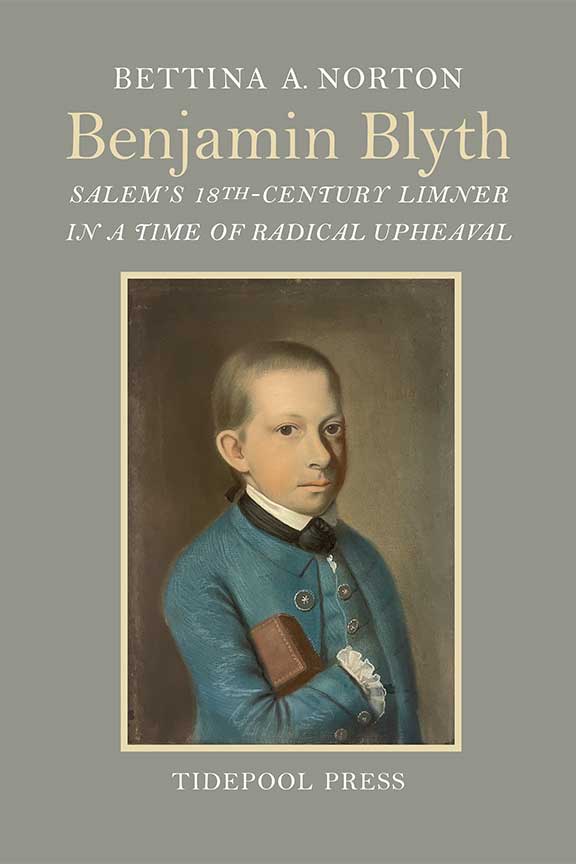
Nationally known, the pastel portraits Adams at the Massachusetts Historical Society are icons of early Federal history; yet accomplished and prolific as the artist was, Benjamin Blyth is largely unknown today, especially compared to his famous contemporary Gilbert Stuart. Other sitters painted or sketched by Blyth include the only known portraits of Dr. Ezekiel Hersey, whose bequest founded Harvard Medical School; Gen. Israel Putnam, hero of the Battle of Bunker Hill; and the family of Elias Hasket Derby, “America’s first millionaire.” Blyth is well represented in John Langdon Sibley’s multi-volume accounts of late seventeenth- and eighteenth-century Harvard graduates, which include nine Blyth portraits of subjects for whom no other image exists. He was an important, if under-recognized, contributor to the visual iconography of the era.
Art historian Bettina A. Norton’s Benjamin Blyth: Salem’s 18th Century Limner in a Time of Radical Upheaval is a long overdue, defi nitive account of Blyth’s life and work. Included are 153 portraits (pastels, oils, miniatures and prints), more than twice the number previously known. A measure of Blyth’s talent is that a dozen had been attributed earlier to John Singleton Copley. Adding to the appeal of Benjamin Blyth, Norton’s astute assessments treat Blyth’s portraits as character studies rather than simple likenesses of the formidable figures who sat for him during this formative era of American history.
This beautifully written, beautifully designed, book adds significantly to our knowledge of Benjamin Blyth and Salem in his time. —Theodore E. Stebbins, Curator emeritus of American Art, Harvard Art Museums, former John Moors Cabot Curator of American Paintings, Museum of Fine Arts, Boston
Bettina A. (“Toni”) Norton’s catalogue of portraits by Benjamin Blyth isn’t just an addition to our knowledge of revolutionary period art in America, it is a manual of how an oeuvre catalogue should be researched, organized, and indexed. Norton checks every box: stylistic and technical analysis, archival research that goes beyond Blyth into life and times in Salem, provenance study (of collectors and especially of dealers who might have restored or forged Blyth works). She even identifies as an attribution aid the 48 frames that still survive among Benjamin’s 151 known pastels, which were made by his brother Samuel, who made some portraits as well. Norton sorts them all out. Her stylistic analysis is serious, occasionally funny, and never partial. Blyth’s hands are routinely “boneless,” but she does rightfully praise his capture of men’s and women’s diverse personalities. —Marjorie B. Cohn, Carl A. Weyerhaeuser Curator of Prints, Emerita Harvard Art Museums
The artistic work of Benjamin Blyth has long been valued by students of American history, his depictions of well-known sitters from Abigail Adams to General Israel Putnam treasured and often reproduced. All of Blyth’s known work in pastel, oil, and print, including many newly attributed portraits, have now been gathered in Bettina Norton’s invaluable biography and catalog, richly illustrated and expertly described with extensive annotation and notes. Bewigged gentlemen in their best coats, women dressed in elaborate lace caps, and children holding their pets, all look out at us from the eighteenth century. Norton’s extensive research into Blyth and his sitters’ social, familial, and political connections weaves together everyday life in Salem, Massachusetts, and connects that individual place and the people who lived and died there to the larger story of change as a nation was being born out of conflict and commerce and a colonial past. —Lauren B. Hewes, Vice President for Collections and Andrew W. Mellon Curator of Graphic Arts, American Antiquarian Society
Bettina Norton’s comprehensive study of Benjamin Blyth is a splendid piece of research and a joy to read. She has restored an artist’s reputation and identified additional examples of his work, putting to rest some old myths and attributions and providing significant new information. Like Blyth’s portraits, Norton’s prose has captured the people and the spirit of Revolutionary War-era Salem, Massachusetts. Her narrative describes Blyth’s artworks in pastel, oil, and miniature, and his collaboration with his brother Samuel in printmaking. The substantive catalogue provides definitive data as well as addressing possible—and dubious—attributions and sitters. It is a testament to the importance of Blyth’s career and Norton’s lengthy effort to bring him the recognition he deserves. —Helena E. Wright, Curator Emerita of Graphic Arts, National Museum of American History, Smithsonian Institution
Reviews
There are no reviews yet.