My wife, Sandy, and I wanted to read it to each other before heading out to the Berkshires to see a production (July 21) of the play at Shakespeare and Company in Lenox. (Starring Christopher Lloyd!)
Before making an online purchase of a digital or inky version, I decided to wait until I got to an actual bookstore.
The opportunity surfaced when a son visited on leave from the Navy. On Friday, we drove to Worcester’s TidePool Bookshop, owned and run by my sister and brother-in-law, Huck and Josephine Truesdell.
As it happened, the store did NOT have a copy. (If I had known the line, I would have Leared, “I have full cause of weeping!”)
But Josephine had a solution.
“I have five copies of King Lear at home,” she said. (Who among us can say that?)
She grabbed some car keys and headed out the door. I grabbed a wallet and headed out another door to buy four grinders for lunch. I looked forward to sinking my teeth into a gently-used Pelican paperback of King Lear.
She returned with two of her copies—fully 40% of her holdings.
The newest one was published in 1881—part of a 20-volume “Harvard Edition” set, edited by the Rev. Henry N. Hudson and published by Ginn and Heath in Boston.
The older one was published in 1868– in English by the famous Tauchnitz operation of Leipzig.
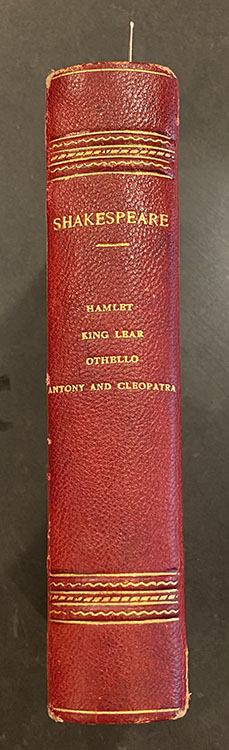
I might have more to say about those, but I’ve been caught up in the most distinctive thing about the older volume, which includes Hamlet, King Lear, Othello, and Anthony and Cleopatra. (See the book’s spine at right.)
The book included something that readers will NEVER get from a Kindle.
When I opened the book, out popped a postcard that had been wedged for more than half a century between two pages of Hamlet.
The card was addressed to great-aunt Dorothy Lincoln and her husband, George. It announced the specifics of the November 9, 1959 meeting of The Shakespeare Club of Worcester, which was in the middle of its 73rd season and is STILL running. The card invited members to attend a reading of Act II, Scene 2 of Hamlet at the Hurlburts’ home on Saxon Road.
Sometime on that Monday, Dorothy tucked the invitation inside her 1868 volume of Hamlet et al and headed north with George from their home in Woodstock, Connecticut.
I imagine that they and others enjoyed hearing fellow members read the scene, which includes the arrival of Rosenkranz and Guildenstern).
At some point during the fairly-long scene, Dorothy’s mind must have wandered a bit. Was it getting too hot in the Hurlburts’ living room? Were some voices too weak? Did she wish she were home watching Father Knows Best or the Danny Thomas Show?
For whatever reason, Dorothy started looking around the room at the others in the audience. She noticed a stranger sitting nearby. Who the heck was this guy? A new member of the Shakespeare Club? A prospective member? Someone’s relative?
For some reason, she could NOT WAIT for the scene to end. She could NOT WAIT for the post-reading social hour when members would gather around the “punch” bowl.
She needed to know NOW.
What to do?
Dorothy, 72 years old at the time, could not whisper her question to—I’m guessing here—her 81-year-old sister-in-law. She did not want to disturb the readers or listeners. Of course, she had no iPhone to send a quick text. She could not slide into a DM. And, unlike other family members, she had not yet mastered any level of the Jedi Mind Trick.
But Dorothy did have some great tools for quick, stealthy communication: a pencil, a postcard, and a cooperative, knowledgeable respondent. (She did not want someone to reply the way Ophelia did to Hamlet’s missives: “I did repel his letters….”)
Holding the card upside down, as Ophelia, Gertrude, Polonius and the rest droned on, Dorothy jotted her question across the card.
In the style of any resourceful fourth-grader, she passed the card and to someone seated nearby who, fortunately, also had a No. 2 pencil and knew the answer to Dorothy’s furtive question.
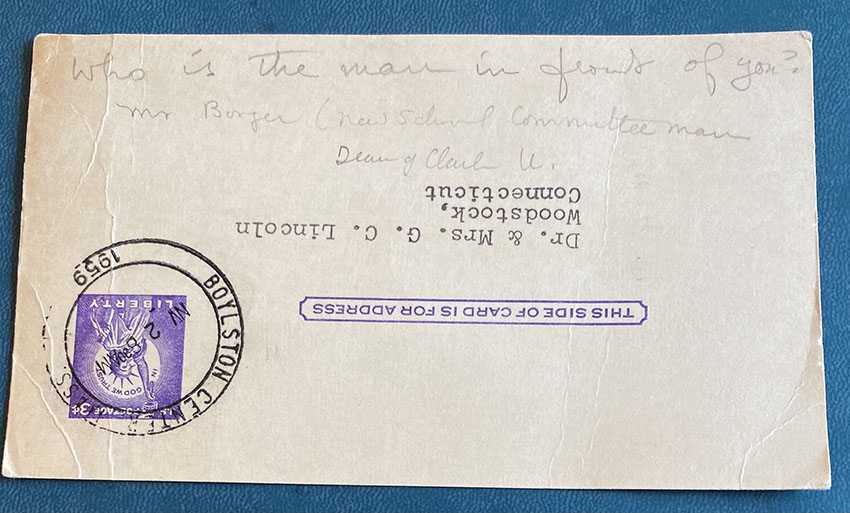
Here’s the exchange:
[Sitting
Dorothy. “Who is the man in front of you?”
Unknown. “Mr Borger (New School Committee Man) Dean of Clark U.”
[Exeunt
Much as I wanted to dig into King Lear, I found myself more interested in the mysterious “Mr Borger”—a man who had caught Aunt Dorothy’s happily-married eye in that house on Saxon Road sometime after 7:45 p.m. on Monday November 9, 1959.
Here I offer some tidbits about the man, who certainly seems worth knowing about
—an academician, athlete, war hero and family man.
BEFORE the Hamlet reading:
Henry Charles Borger Jr. was born in 1911 in New York City. He grew up in Westwood, N.J. His dad was, among other things the president of a cotton manufacturing firm in the Bronx. He attended the Peddie School and graduated at Princeton in 1933, earning two varsity letters in baseball. He married Marian Flege of Brooklyn in 1936.
He held a master’s and doctorate degrees from the Teachers’ College of Columbia University.
During World War II, he served in the Army and earned a Bronze Star. He stayed in the Army Reserves and attained the rank of colonel. At some point he taught at Freehold Military School, Peekskill Military Academy and the Birch Wathen School in Manhattan.
He had been at Clark University since 1950, serving as a professor of education and then director of admissions. By 1959, he was dean of students. He was elected to the Worcester School Board just before that Hamlet reading in November 1959.
AFTER the Hamlet reading:
I hope Dorothy got a chance to chat with Henry because he was days away from a sad family event. Nobody knew on that evening of November 9, that Henry Borger’s dad (Henry Sr.) would die THREE DAYS LATER on Nov. 12, 1959—at age 76 in Decatur, Ill.
Henry Jr., of course, continued his professional and civic work in Worcester. (Two years later he was the No. 2 vote-getter in the school-committee race, behind only the very popular Helen Bowditch.)
In 1965, Henry Borger became president of Leicester (Mass.) Junior College in 1965. He held that position until his retirement in 1975. He was very involved in Worcester’s civic life. He later volunteered as an interpreter at Old Sturbridge Village.
He died in 2002 in Beverly, Mass.
Now you, too, can respond to the question: “Who is the man in front of you?”
Hmmmmm.
How on earth can I bring this back to the King Lear production of this week. I got it.
It turns out that a son of Henry and Marian, named Frederick Borger, was a teacher at the Lenox School for Boys in 1966.
And by now you might suspect where Shakespeare and Company is located! Yes! On the campus of what was once known as the Lenox School for Boys.
Do I think someone in the crowd of Shakespeare-lovers will notice me and pass a message to friend who happens to be sitting right behind me? Might they text, “Who is the man in front of you?”
I really hope that the texter would not need to add: “Wake him up!”
]]>Some things make little sense.
Like what I read and where and when I do it.
Plagued by self-consciousness, I find that a Kindle aids me in this regard. I can read with an air of mystery. Nobody knows what I’m reading (imagine, for a second, that they might care).

On Saturday morning my burgundy-encased Kindle provided cover for my reading of a new thriller by T.J. Newman called Falling. In this case, I was grateful that nobody nearby knew I had my head buried in a book about perils in the air. If they knew, they might have given me a wider-than-six-feet radius. I was, after all, sitting in an airport, waiting by the gate for a flight—you know, clambering into a heavier-than-air container that would somehow take me to Boston.
One of the big promoters of the new book is author Don Winslow. I like his fast-paced writing. Among other things, he blurbed this about Falling:
“This is Jaws at 35,000 feet.”
Evidently, that did not bother me. After all, my 40-minute Cape Air flight was probably not taking me any higher than 5,000 feet. Not the same thing. Right?
My serenity about it hit an air pocket when I read the first sentence: “When the shoe dropped into her lap the foot was still in it.” Uh, I thought, maybe wait until later in the day.
Amazingly, as the loudspeaker announced boarding for another flight, I read the second sentence: “She flung it into the air with a shriek.”
Fully engaged, I plunged into it. I kept reading. During the one-hour delay for takeoff. During the flight. During the Uber ride.
The New York Times reviewer had a different approach. She did not read it on a plane. She did not read it at an airport. In her review published/digitized on July 7, Tina Jordan wrote, “When I finished, all I could think was, I’m so glad I didn’t read this before I got on my first post-lockdown flight last month.”
]]>For his final word on the ESPN broadcast of Denmark’s 2-1 win over the Czech Republic in the Euro 2020 quarterfinal match in Baku (!) on Saturday July 3, an announcer turned to literature to capture the moment.
He (either Derek Rae or Efan Ekoku) pulled out a quotation by Danish fairytale-teller Hans Christian Andersen (1805-1870) (at right) that a producer had dug out just for this moment:
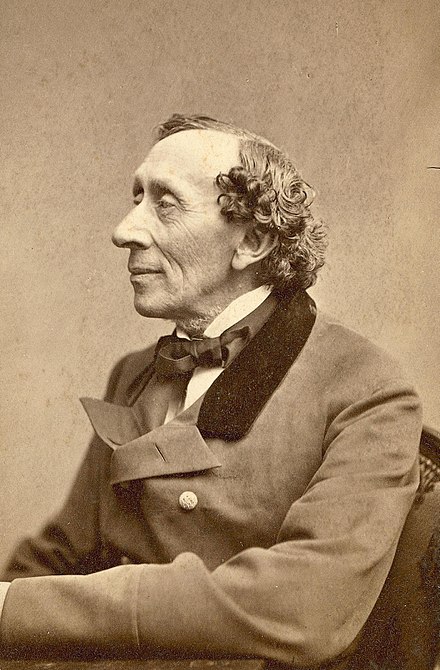
“Life itself is the most wonderful fairy tale!”
The fact that Denmark was going to be one of the Last Four teams standing in the tournament seems plucked from the world of make-believe. (Aside: I love the way ESPN presents the flags of the nations in the tournament, above.) Three weeks earlier, during the team’s first game in the tournament, their best player (Christian Eriksen) had collapsed, apparently toppled by a heart attack. Somehow, the star-less team has been on a roll. Their story is true Once-Upon-a-Time stuff.
I wondered where HCA had written that quotation, which many people might know from a wall poster or a greeting card. Maybe “The Ugly Duckling”? “The LIttle Mermaid”? “The Emperor’s New Clothes”?
It so happens that the quotation (“Life itself is the most wonderful fairy tale.”) is the last line of his less-known, life-is-good story titled “What the Whole Family Said” (“Hvad hele Familien sagde”). HCA put the words in the mouth of the family’s Godfather, who lives comfortably in the attic of a house populated by numerous relatives.
Here’s the last paragraph of the story, from a version on the site of the H.C. Andersen Center of the University of Southern Denmark, translated by Jean Hersholt (who did not include the word “itself”). The “He” is the well-spoken Godfather.
“He knew all stories, all the fairy tales. And it was right from the bottom of his heart that he said, ‘Life is the most wonderful fairy tale of all!”
For any additional Denmark victories—the team played England on July 7–the announcer can use another HCA phrase and call the victory “The Most Incredible Thing” (“det utroligste”). That is an amazing tale first published in the U.S. in 1870. Author Abbott “Tom” Gleason referred to in Chapter 11 of his 2010 TidePool book, A Liberal Education.
For any additional Denmark victories—the team plays England on July 7, the announcer can use another HCA phrase and call the victory “The Most Incredible Thing” (“det utroligste”).
That is the title (sometimes with “Unbelievable”) of an incredible/unbelievable tale. It happens to be mentioned on pages 281/282 of the 2010 TidePool book by Abbott (Tom) Gleason, A Liberal Education.
In Chapter 11, Gleason described the tense student-takeover days at Harvard in the spring of 1969. This fairy tale came up during a crucial faculty meeting held on Friday April 11 (and summarized in a nearly-verbatim kind of way by Harvard’s president two days later in the Boston Globe).
Here’s the fairy tale–VERY BRIEFLY–and a professor’s retelling of it–VERY BRIEFLY:
A King of a certain Kingdom announced he would, in the words of economics professor Alexander Gerschenkron, “give the princess’ hand away in marriage to a man who would accomplish the most unbelievable thing. [emphasis added]”. Judges were just about to give the top prize to a handsome young man who built a wondrously intricate clock. Before they could bestow the top prize to that man, a “low-brow” guy walked in with a sledgehammer. As Gerschenkron put it: “He walked up to that block and with three blows he smashed up the clock.”
The judges had no choice. They gave the award to the destroyer. (Rest assured, Andersen worked things out for the handsome man and the princess.)
In Liberal Education, Gleason wrote, “The smashing of such a magnificent artifact was even more ‘unbelievable’ than its creation.”
Gerschenkron told the faculty that Harvard was that intricate clock, “a frail and fragile creation,” which must not be destroyed by the student protesters.
Gleason noted: “Gerschenkron let Harvard off the hook entirely for the troubles through which the university had been going.”
A Liberal Education by Abbott Gleason