Fortunately, I’m a slow needle-pointer. Steady, sure. But slow.
The downside of this is that I can spend months (years?) on a project. The upside? This glacial pace allows for some thinking. And overthinking.
I’ve done a lot of pondering during my current project.
This is a 14-inch-by-10-inch canvas showing a shelf of seven books. As soon as I saw it at the Stitch Boutique in Winchester, I knew I had to give it a go. They loaded me up with silk threads (Captain’s Blue, Jet Black, Canyon Sunset etc.).
These are, of course, some of the great books. I wanted to honor them in some way, particularly during this time of book-banning and author-shaming.
Before tackling the spines of the books, I worked on the surrounding area–two shelves (with colors like Bark, Dark Earth and Oak Bluffs) and the black background.
While working on the non-book sections, I found I had plenty of time to think of the books themselves.
Great as these eight specific books are, I felt a little ashamed about including a book I had not read. (I’m talking about you, War and Peace.) I decided I should do books that I have actually read.
Of course, that was a daunting chore. I never kept a list. It so happens that the books I seem to recall most intensely are the ones I read as a teenager, say between the ages of 10 and 18. Of course, that decision eliminated many wonderful books—where to begin? Cloudsplitter by Russell Banks; A Different Drummer by William Melvin Kelly; and, most recently, City of Thieves by David Benioff.
Once I focused on the timeframe (circa 1962-1970), I realized I needed to narrow the list further. In keeping with the needlepoint canvas in hand, I thought I had to focus on fiction.
That meant I had to shelve (ha, ha) some of my favorite books from those years. Among them: Black Like Me by John Howard Griffin; The Other America by Michael Harrington; A Sand County Almanac by Aldo Leopold; Silent Spring by Rachel Carson; The Babe Ruth Story (as told to Bob Considine); and (embarrassingly) Worlds in Collision by Immanuel Velikovsky.
So that leaves me saying, “Alex, I’ll take fiction books I enjoyed as a teen-ager for $200.”
What are the eight novels I most enjoyed as a teenager? That’s a fine question, probably for anyone to ask.
This will not be easy.
First, I have to (needle)point out some serious issues. For example:
- Can I correctly spell “Dostoevsky,” and will it fit on a spine?
- Should I include four books by Tolkien?
- Do I dare let friends and family know how much I furtively enjoyed Lady Chatterley’s Lover?
I will deal with them as I slowly and carefully begin to needlepoint the spines of the books. For the record, I already plunged by tiny needle into the spine of Moby-Dick.
I hope needlepointing M-D won’t take as long as the Pequod’s last sea voyage. That lasted months and months and months and (spoiler alert!) ended rather badly. It will take a few days, though. That will give me plenty of time to think about the other seven Great-to-Me books that I want on this shelf.
I’ll let you know.
]]>One helpful clue (obviously) is the payee: a book store in Andover, which still exists.
Another helpful bit of information is knowing that $1.90 in 1968 is roughly equivalent to $15.28 in 2021. (That takes us out of the penny-candy aisle.)
What on earth might I have bought for $1.90 at that bookstore in 1968? (I am disregarding the 3 percent sales tax because among the many exemptions–including feed, fertilizer, human food, clothing etc.–were books required for religious worship and formal education. That last phrase likely applied to the store because it supplied textbooks and reading material for nearby schools (including the two boarding schools up the street).
There’s a chance the money went for the 1963 edition of Sound and Sense. We used that collection of poetry that we used in English that year (“Ozymandias” and all that). I can’t find that copy so I don’t know what it cost. I still have a copy from that year of C. Vann Woodward’s The Strange Career of Jim Crow. It cost $1.95. Sound and Sense makes…. sense. However, we used that book all year. I should have bought it in September, not January, right?
I’m kind of intrigued by the thought that the $1.90 covered the cost of two 95-cent paperbacks. I like the math. That sounds sensible enough. There were plenty of such books, some published by Dell, for example. I remember holding in high school, if not reading: James Clavell’s Tai-Pan, Erwin Nathanson’s The Dirty Dozen, Bernard Malamud’s The Fixer, Robert Crichton’s The Secret of Santa Vittoria, and Anatoly Kuznetsov’s Babi Yar. Did I buy one of those on January 6?
I know I never touched, bought, or read Jeanette Kamins’ 95-center, A Husband Isn’t Everything. Some paperbacks were less than 95 cents, of course. Richard Fariña’s Been Down So Long It Looks Like Up to Me cost three quarters.
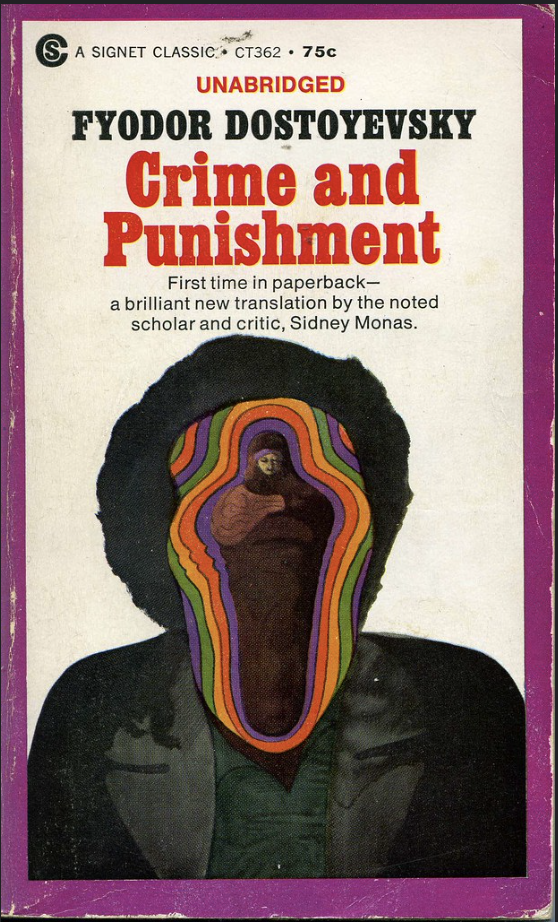
So did Signet’s Crime and Punishment (right). I remember reading that in tenth grade. For some reason that coincided with a decision never to go inside a pawn shop. It came out in early 1968 and cost 75 cents. I definitely remember the cover (right). Was it available in January? Not sure.
Or did I buy Robert Ardrey’s African Genesis–another 95-center from Dell.
Or was it the massive Worlds in Collision by Immanuel Velikovsky, despite its cover price of $1.95? I know I read it that winter. I remember the cast-iron radiator I sat near–looking for warmth, security and protection. The book terrified me. But I could not stop reading it. One source at the time said Velikovsky “propounds the theory that more than once within historical times the earth was subject to enormous cataclysms—deluges of flaming matter, annihilation of large portions of the human race, and destruction of land masses.” Now that’s a pretty good bang for the 1968 buck or two.
But I’ll never know what I bought, no matter how much I ponder, burrow, or Google.
This wasn’t a total waste of time, though.
While looking through paperbacks of the late 1960s, I came across a 1967 survey carried out by the National Council of Teachers of English. According to various newspaper article, the group asked seniors at 116 schools to list the ten most significant books they had read.
Here are the 10, chosen by students, in no particular order:
Lord of the Flies
Catcher in the Rye
1984
To Kill a Mockingbird
Crime and Punishment
Gone with the Wind
The Robe
Black Like Me
Cry the Beloved Country
The Bible.
That’s quite a list. Might serve as a good start for a book-group. I have read seven of them to date, but only five by the time I was a senior in high school.
Many of those still draw praise, and criticism, of course. Catcher in the Rye still rubs people the wrong way. I particularly enjoyed reading about a couple of examples (which MIGHT be true):
First, in the June 1966 edition of the ALA Bulletin (“My Mother, the Censor”), Rozanne Knudson mentions that in the early 1960s one watchdog thought Catcher in the Rye was so horrible that the author had no business being on the staff of the White House under President Kennedy. They, of course, had confused Salingers–J.D. for Pierre.
2. In a master’s thesis from 1968, a graduate student (perhaps falling prey to an apocryphal tale) mentioned that one critic had the name of the author correct but misheard the title. They saw no place in a school reading list for a book with such a raunchy title as Catch Her in the Raw.
]]>
On Saturday (November 6) Kathryn Tsandikos sat at one end of a table chatting with visitors and signing copies of Two Up and a Bag of Chips!, her history of George’s Coney Island restaurant. She was within arm’s reach of a pile of boxes of four-inch snack pies. These were Table Talk pies.
This made sense for the very well-attended session at the TidePool BookStore. The pies came courtesy of Harry Kokkinis, husband of Kathryn and president of the pie-making enterprise.
The name on the boxes (“Table Talk”) fit the occasion.

Kathryn spent lots of time talking at that table. She lingered with each patron who asked her to sign a copy of her 144-page history of George’s Coney Island. Talk included relatives, neighborhoods, restaurant booths, and more. I imagine she gracefully dodged a few attempts to wheedle the “secret-sauce” recipe from her.
While watching the signing/talking, I asked Harry about the origins of the Table Talk name. I assumed it might have been inspired by the 500-year-old collection of sayings attributed to Martin Luther–Table Talk. (In German, it’s Tischreden. The reden verb seems suggests a conversation is going on, as compared to other talk-and-speak verbs such as sprechen or sagen. Maybe Table Chat would be better?)
But I was wrong. There is no connection between the two Table Talks of Worcester and Wittenberg.
Harry said the name goes back to the 1920s when Theodore Tonna and Angelo Cotsidas cooked up the company. They wanted a name based on Tonna’s initials, “T.T.” We did not speculate too much on the double-T names that the founders might have rejected. Tasty Treats? Tempting Tarts? Terrific Turnovers? Tonna and Cotsidas made a Top-Tier choice.
It certainly felt right on Saturday afternoon. “Table Talk” evokes the togetherness and conviviality that many of us may have felt has been missing or minimized during this pandemic. We enjoyed seeing the table-talking going on right before us,
Still, the conversation got me going back to Luther’s Table Talk (which can be bought through TidePool!)
Most of the collection includes Luther’s utterances while relaxing with various companions around the dinner table at the Luthers’ home, Lutherhaus. One scholar summed up the typical guests as “…exiled clergymen, escaped nuns, government officials, visitors from abroad, and colleagues of Luther in the university who frequently stopped in….”).
Luther’s sharing, based on shorthand notes and best-guess memories of some attentive attendees provide some great insight into Luther and his times. Some sharing are long, others short. Here are a couple of samples:
One snippet that might raise an eyebrow or two: “One shouldn’t whip children too hard.”
Another is clearly timeless and relevant: “A lie is like a snowball. The longer it is rolled on the ground the larger it becomes.”
Not surprisingly, food, comes up occasionally during the sessions with Luther. One of the participants, Johannes Mathesius (1504-1565), left this description: “We used to call his conversation the condiments of the meal because we preferred it to all spices and dainty food.”
It’s no disrespect to say that I think the four-inch pies and Coney Island hot dogs fell into the category of “spices and dainty food” on Saturday. Kathryn provided the condiments.